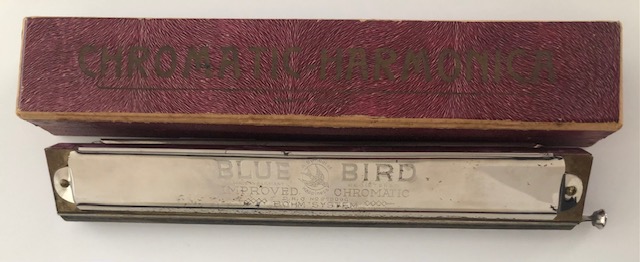
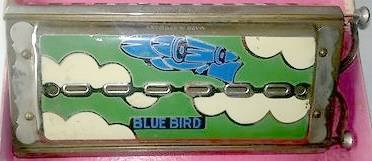
It is amazing how much R&D Böhm must have done to come out with such a great variety of chromatic harmonicas. I have written at least three more articles about the various chromatics Böhm manufactured. This Böhm Blue Bird improved blow chromatic with 22 holes is the widest chromatic harmonica I have ever owned. Interestingly enough, on its covers it shows the same DRGM 978090 (Deutsches Reichsgebrauchsmuster -> basically the registration to offer a basic copyright protection for design or function ) as the other Böhm Blue Bird Improved Chromatic. This DRGM was registered in 1922 which should give an indication when the instrument was manufactured.
Böhm Blue Bird improved blow chromatic, from my collection
Even though the instrument is much wider than a standard 4 octave chromatic harmonica it actually has a range of only 3 octaves, starting from f – f3. This is based on the fact that it is a blow only chromatic. Sharps and flats can be played when pushing the slide.
This is the node order:
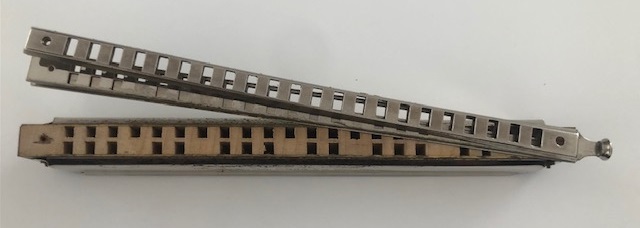
Unscrewed mouthpiece showing the wooden comb and channels
When I first saw the comb surface it seemed like the comb was made out of some kind of plastic. After removing one screw of the mouth piece it was revealed that the comb mostly consists of wood. The plastic is just a protective coat. It also gives the instrument a distinct mother-of-pearl look.
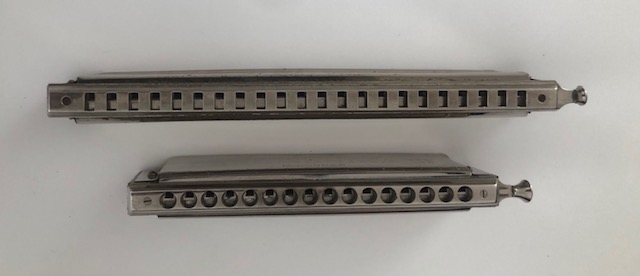
The outside of the comb has a protective plastic coatingCompared to a four octave chromatic harmonica the Böhm Blue Bird chromatic looks enormous
There is a huge variety of chromatic harmonicas with enameled covers.
The Emil Friedel company produced some wonderful art harmonicas, so did F.A. Böhm.
The first Hohner Larry Adler harmonicas (10 and 12 hole) came with colored covers. There is also a series of 10, 12 and 16 hole Bandmaster harmonicas with beautiful ornamentation.
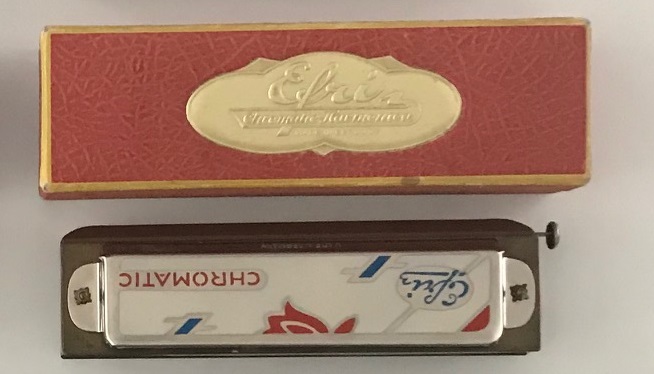
Emil Friedel, Efri chromatic, from my collection
Emil Friedel four octave model
The junior (bottom) and standard Larry Adler chromatic harmonicas with enameled covers, from my collection
Blue Master chromatic with beautiful ornamentation, from my collection
Variety of enameled chromatic harmonicas, from my collection
The concept of coloring chromatic harmonica cover-plates must have already been around since the 1920th. At that time, there were already chromatic harmonicas with external spring and enameled covers available.
Enameled Böhm Blue Bird and Radio Tone chromatic harmonicas with external spring
The idea of combining two chromatic harmonicas into one, usually a C and G tuned instrument, must have first come up in the 1920s. My assumption is that the first company to actually manufacture such an instrument was F.A. Böhm. However, I was not able to confirm that by any patent. The first double chromatics had external springs. which were very common in the 1920s. F.A. Böhm also produced a double chromatic for Gretsch around the same time.
Gretsch double chromatic, from my collectionF.A. Böhm Blue Bird enameled version from the John Whiteman collection
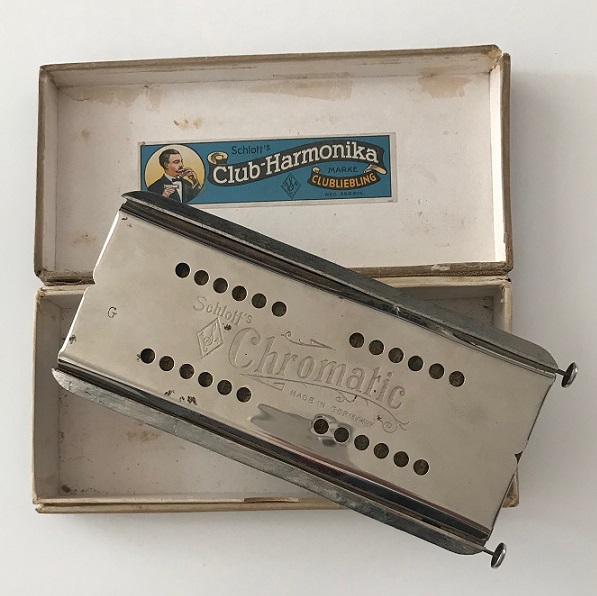
Later models like the Schlott double chromatic had internal springs.
Schlott double chromatic, from my collection
There is also a similar model made for Gretsch. It is part of the Alan G. Bates Harmonica Collection at the National Music Museum of the University of South Dakota. Bates also wrote, “This double-sided chromatic harmonica in C and G was a short-lived experiment. Most chromatic players became adept enough to play in any key on a C-tuned instrument, so a second key was unnecessary.”
Recently, I saw a picture of another double chromatic by the Emil Friedel harmonica company. The fact that this model seems to be rather post-war, maybe around the 1950s, contradicts Alan Bates’ assumption.
Emil Friedel “Efri” double chromatic harmonica belonging to the Peter Widenmeyer collection
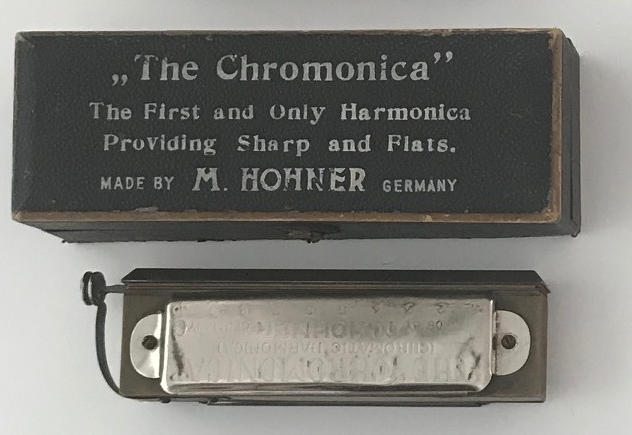
The next leap in chromatic harmonica development came from Hohner in 1910.
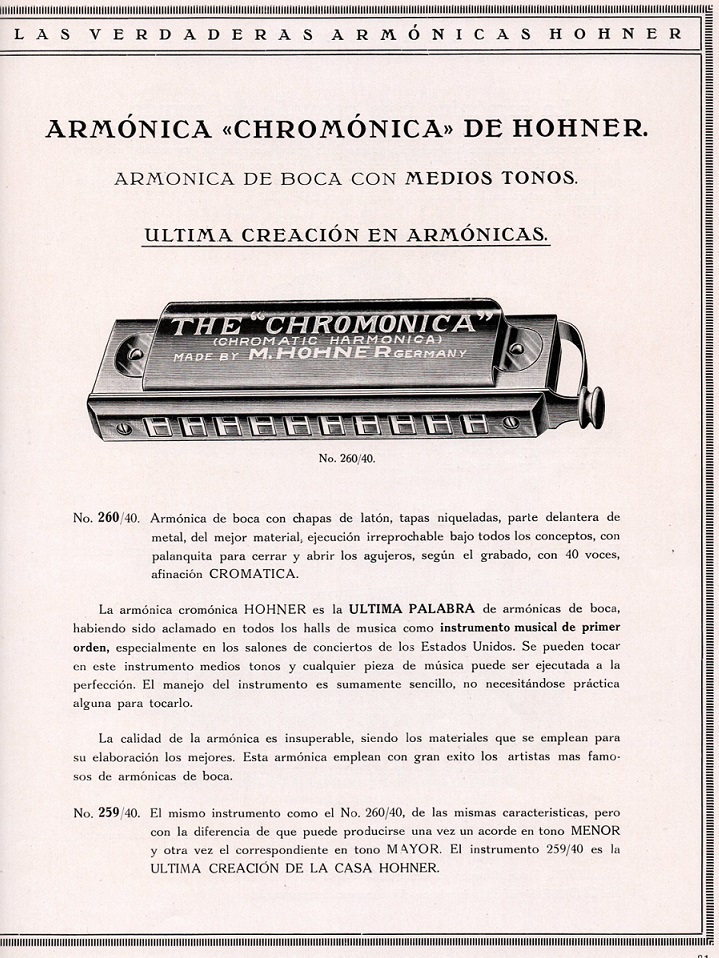
“The Music Trade Review” first ad of the new Hohner chromatic harmonica in 1910Hohner “The Chromatic Harmonica”, the one from my collection (dates back to 1910)Later it was renamed to “The Chromonica”, part of my collection (around 1920)The “Chromonica” called No. 260 with external spring from the 1929 Spanish Hohner catalogue.
The Hohner chromatic harmonica was the first one with an external spring. From that moment on the external spring was the de facto standard. It was used for practically all chromatic harmonicas until about 1930 with few exceptions.
Borrah Minnevitch slide chromatics with external spring, from my collection
Side note: the US patent# 1671309 for the Hohner Chromonica was issues in 1928. The application for this patent was made in 1926, some sixteen years after the Chromonica was first advertised.
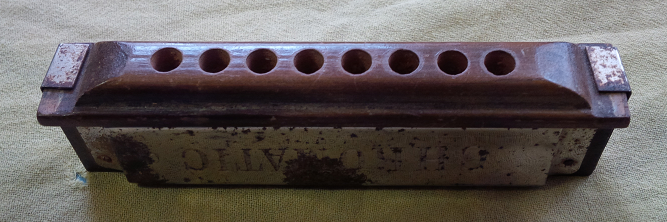
F.A. Rauner vertical slider chromatic, courtesy Paul Neupert
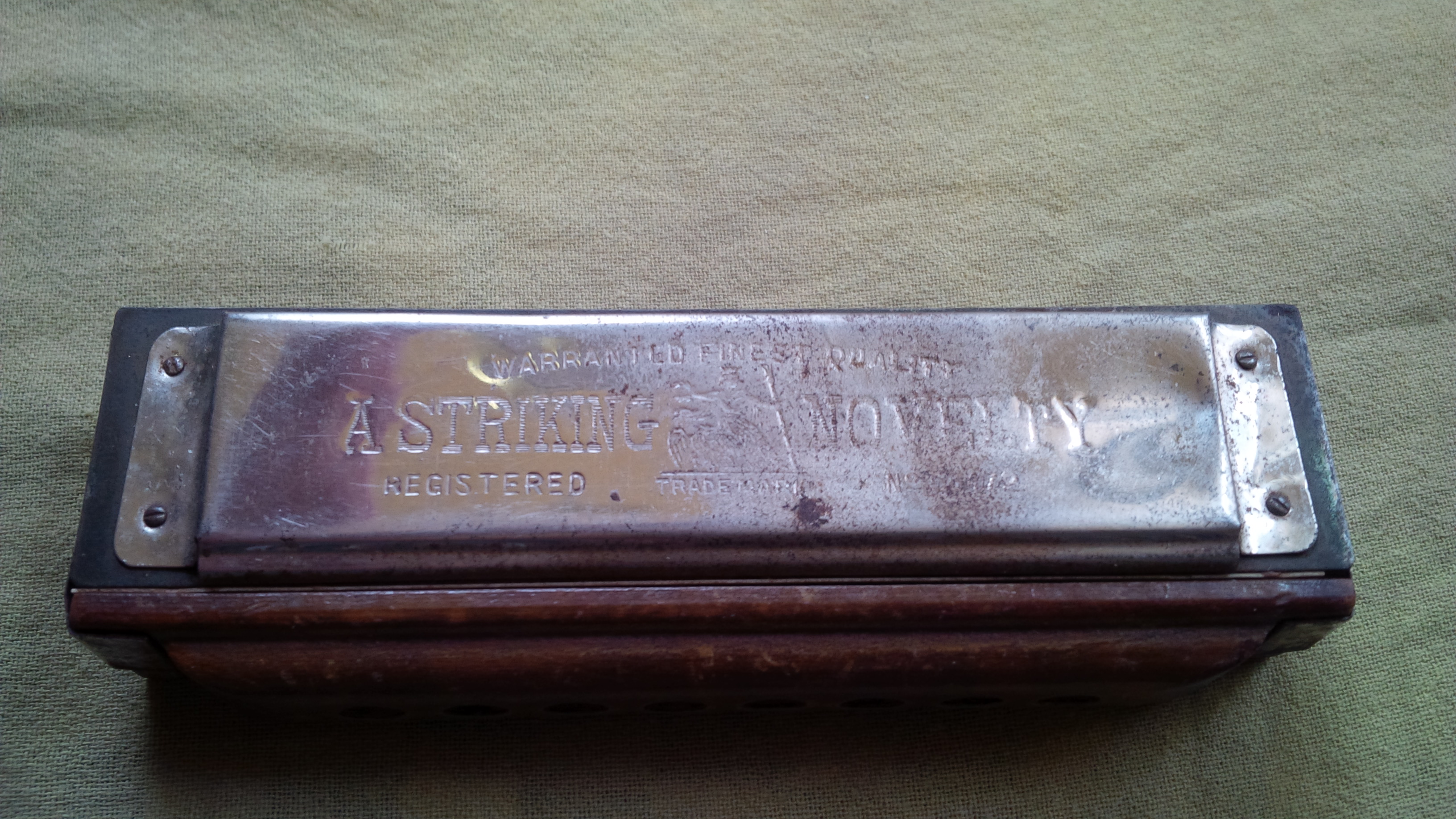
The top cover plate of the F.A. Rauner vertical slider chromatic states “Chromatic”. The lower one reads “A striking novelty”.
The cover plates state “A striking novelty”, courtesy Paul Neupert
Well, in general it was a novelty but the idea is similar to the Carl Essbach harmonica from my previous post that came out about 18 years earlier. The DRWZ 53172 (Deutsches Reichs Waren Zeichen, ‘Imperial German trademark’) was issued in 1902, which gives an indication when the F.A. Rauner chromatic came out.
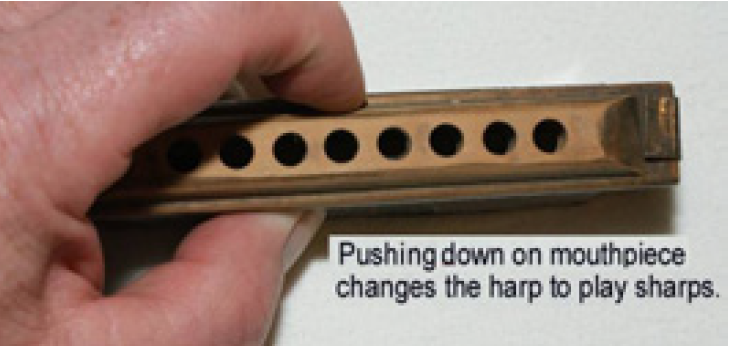
Vern Smith made the following observations: “I discovered some interesting things about it that would not have been otherwise apparent: Steel reeds and plates! Springs too strong for easy playing, a design defect. Vertical motion longer than needed. Mouthpiece in the “up” position does not completely block air from the lower reeds, a manufacturing defect. The tuning layout that covers 2.8 octaves in 8 holes, has a blow-C chord, and raises the pitch of all natural notes by a half-tone when the mouthpiece is pushed down. Leakiness that arises from age and abuse. The important thing about this harp is that it was designed for playing chromatic music and not for merely changing keys. I speculate that the design goal was to avoid the cost and complexity of a metal slide mechanism”
I guess it is save to assume that based on Vern’s observations the vertical slider harmonica was not really a great success due to its design flaws. But it allowed for playing chromatically.
Just recently, Phil Sheppard (Shep), author of the wonderful blog “Harmonica Riff Raff“, made a spectacular find while exploring some antique shops in the middle of Tasmania, Australia. The harmonica he found, a chromatically tuned Up To Date model manufactured by Hohner, is most likely the first real chromatic harmonica ever commercially available.
It was first mentioned in the 1898 edition of the Music Trade Review:
“We have just received the latest novelty in mouth-harmonicas. It is the most recent of Hohner’s famous products in that class, and is first-class in every particular. The name ‘Up-to-Date’ describes it exactly. It is chromatically tuned and is the only mouth-harmonica on the market having sharps and flats.”
Hohner “Up To Date” chromatically tuned harmonica, from Phil Sheppard’s collection
According to Pat Missin, Hohner produced more than sixty different models bearing the name Up To Date. Some of them must have come out around the same time (one patent dates back to August 24th, 1897) as the chromatically-tuned version.
Even though the cover plate states “patented in all countries”, I was not able to trace a patent for this chromatic model.
Interestingly enough, F.A. Böhm owned patent #100650, granted in 1898. The slider in the drawing clearly resembles that of the Up To Date one. But the harmonica described was not meant to be played chromatically but rather to produce trills. By taking a closer look at the slider, one realizes that the reed plates extend at the top and therefore create the track for the slider. The mouthpiece is situated above the reed plates. Sitting on top of a celluloid strip and in between the reed plates resides the slider. That is a very clever construction. I have never seen any other manufacturer using such an approach.
I do see a problem with this construction though. Maybe that is why this was not used in later chromatic harmonicas. In order to get that to work, the reed plates must be spot on and evenly attached to the comb, otherwise it won’t be airtight. This is certainly not easy to do.
Closer caption of the slider construction
Since the slider divides the chambers vertically (not horizontally as in later chromatic harmonicas), my assumption is that the comb consists of 20 single chambers. Each chamber hosting a blow and draw reed.
Slide in either normal position or pushed in
Slider disassembled (picture, courtesy Mark Hand)
I was curious to find out more about the order of the reeds. Shep was so kind to provide some audio samples:
Based on these samples, it is pretty clear to me that the notes order consist of a C and a C# (slide pushed in) scale. Just like later chromatic models.
I am really surprised how advanced the Up To Date chromatic was for its time. It puzzles me that it was commercially not very successful. Maybe because it was such a new concept. Another possibility was that the slider did not seem to work very smoothly (as confirmed by Shep). Perhaps that is the reason it took Hohner another 12 years to come out with “The Chromatic Harmonica“.
Update: based on additional photos provided by Joel Andersson I can add more info to this article:
looks like Hohner worked on different variants of the Up-To-Date at the time. This prototype uses a different mouthpiece including a button for the slider. When pushing the button the whole mouthpiece moves to the left and when releasing back to the right.
A different variant of the Up-To-Date chromatic with slider button, courtesy Joel Andersson
Video demo of Up-To-Date chromatic slider button, courtesy Joe Andersson
In addition, this prototype with “The Chromatic Harmonica” covers but the Up-To-Date mouthpiece and slider might have been from around 1910 when Hohner introduced the first “The Chromatic Harmonica”. It seems like this prototype already uses an internal spring which would have been way ahead of its time. The internal spring was introduced by Hohner around 1930.
Additional prototype with “The Chromatic Harmonica” covers, courtesy Joel Andersson
Great news! The harmonica museum in Trossingen was able to acquire another Hohner “Up To Date” chromatically tuned harmonica. It was donated by my fellow harmonica collector Mark Hand.
Thank you so much for that! There is an article (German and English) about the “Up To Date” on the museum’s website. Thank you for mentioning my blog, Martin! 🙂
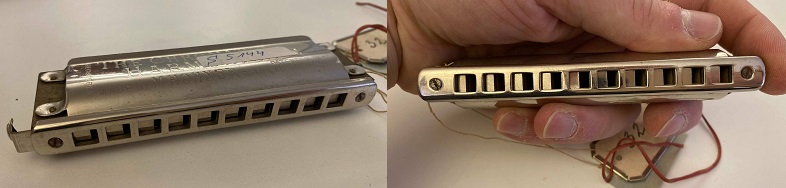
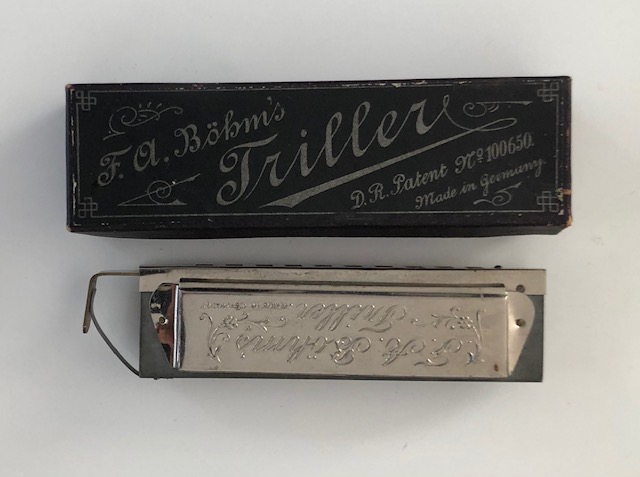
The Bohm “Triller” harmoncia must have been manufactured around 1898. That is the year the patent #100650 was granted.
Bohm “Triller” from 1898, part of my collection
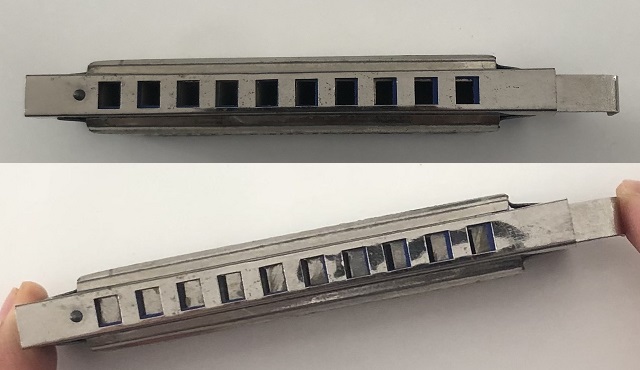
The “Triller” is not a chromatic harmonica per se but the slider mechanism is similar to the one used in early chromatic harmonicas. A similar slider was used for the Hohner “Up To Date” which came out the same year.
Slider in basic position and pushed in
The slide used for the “Triller” just creates some trill sound effects.
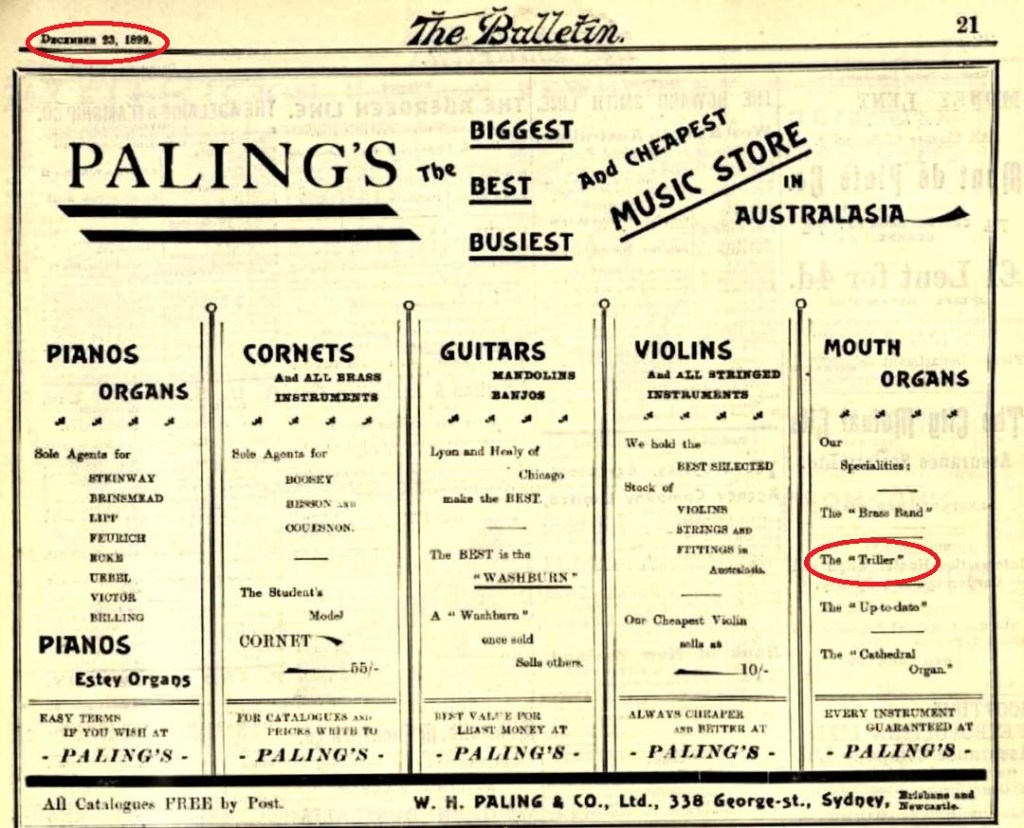
Paling’s music store bulletin from 1899 advertising the “Triller”, courtesy of Phil Sheppard (Shep)Pushing the the slide in and out creates some sound effects
The principle idea of the slider and sound effect is similar to the one used for the “Meine Mandoline” harmonica (scroll to the bottom of the page), also manufactured by Bohm.
It is difficult to say who actually invented the first functional chromatic harmonica. John Broecker quotes (reply #5): “The first known patent for a slide chromatic harmonica was a British patent #2716 from 1862, patent owner’s name unknown. The reed placement system used is unknown. “ It is difficult to verify that quote. I could only find the following additional info on a German site: “1862 – Eine chromatische Mundharmonika wird in Großbritannien patentiert. [5]” [5] Persönliche Mitteilung von Otto Becker unter Berufung auf das Deutsche Harmonika-Museum, Trossingen und auf Pat Missin. Pat Missin wrote in a response when asking him about patent# 2716 : “The patent does not cover a slide chromatic, it doesn’t even cover a harmonica. It is for a chromatic pitch pipe, granted to one William Chesterton Burden. “ The patent# DE19331A from 1882 by Adolf Glass Junior shows a harmonica that certainly could have been played chromatically (as much as the previously mentioned Johan Richter harmonica could have been). It does not explicitly mention that, though.
1886 wholesale catalog issued by John F. Stratton (courtesy of John Whiteman) showing an illustration of the Glass Junior harmonica
Another patent of another candidate comes form the same year, 1892. It was Johann Wilhelm Schunk (not clear if he was related to Johann Erdman Schunk, the founder of the Schunk harmonica factory ) who patented (patent# DE19222) his idea of a harmonica with a slider that allows switching between the top and the lower reed plates. He writes “this will allow to switch between different scales”. He does not exclusively mention it would allow to play chromatically.
The museum also features a 1884 patent# DE25587A granted to Seydel. An article about that patent was written by the “Freie Presse” newspaper. It states the patent was issued to Seydel and that it is the first known chromatic harmonica patent. The patent does not exclusively mention “playing chromatically”. It just describes another way to switch between reed plates. Therefore, in my opinion this article was not really accurate. Coming back to the Carl Essbach harmonica, I have not seen anybody operate or play that harmonica. Based on the description of the patent, the assumption is that the wooden mouthpiece can be moved vertically by pushing down the two buttons (located on the top left and right corners). That way, the player has either access to the upper, or when pushing down the two buttons, the lower reed plate and is therefore able to play different scales. Update: I recently visited the Klingenthal-Zwota harmonica museum and was able to operate the Essbach harmonica. When pushing down the two buttons the inner body moves down and when releasing up again (via two bendable metal plates residing inside the comb at the right and left side -> see patent# DE25587A) Therefore, it is not the mouth piece that moves but rather the harmonica comb. This is a very interesting mechanism. I wish I would have had more time to explore that.
Carl Essbach harmonica, the harmonica comb inside the static metal frame can be pushed down to switch reed plates
Essbach harmonica: how the mechanism works
Similar concept: Hohner prototype of movable harmonica body (around 1920) from the Harmonica Museum Trossingen, courtesy Joel Andersson
Hohner prototype of movable harmonica body, courtesy Joel Andersson
The first time a chromatically tuned harmonica was mentioned in a patent (at least as far as I could find) was in 1896. The patent# DE95610A issued to Christian Weiss explicitly mentioned the name “chromatic harmonica”. The harmonica described is not a slide chromatic. It has only two reed plates. The blow reeds can be used to play a c-major scale. The draw reeds will fill in the missing notes in order to play fully chromatic.
At that time, Hohner did not seem to have filed for any patent regarding some sort of chromatic harmonica; however, I could find these drawings of two prototypes in the book “100 years of Hohner”. The description states: these two harmonicas can be seen as predecessors of today’s Chromonica.
From the book “100 years of Hohner”
The second harmonica in the above drawing actually exists. I saw it in a video produced by the Norwegian television (starts at about 6:12). The famous harmonica soloist Tommy Reilly is trying it out. He plays a couple of notes and also turns the button to play different notes. Difficult to say if the tuning is actually chromatic.
Harmonica prototype from the old Hohner museum (see also image above) with a round knob to change between different scales
Similar mechanism as above. This harmonica from the harmonica museum in Trossingen mentions the name chromatic harmonica on the cover (date unknown)
Update: I found this link to a video directed by Chris Morphet and made available by Roger Trobridge “Visit to Hohner Factory in 1972”. At about 4:40 Manfred Haug (one of Hohner’s former directors) mentions that the above harmonica is a Hohner chromatic harmonica prototype from 1910.
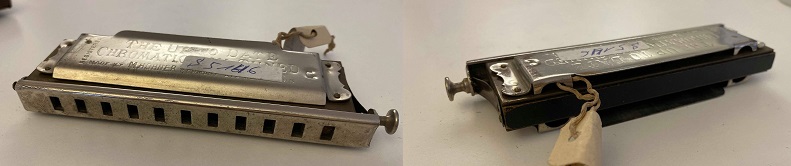
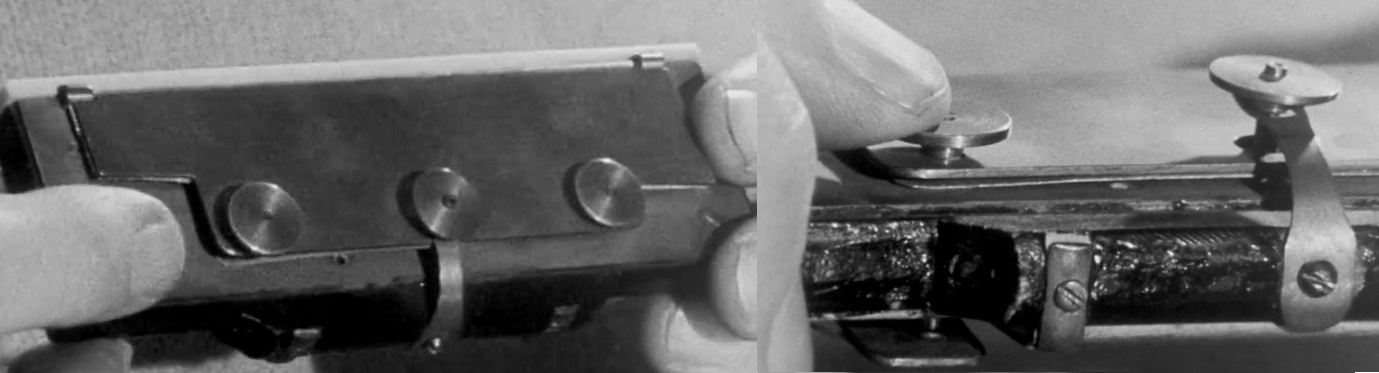
Update: this year I was able to go back to the museum to uncover at least some parts of the mystery regarding the Seydel and Bohm chromatic harmonicas. I especially want to thank the museum to give me the opportunity to inspect the below harmonicas and provide additional information. Both harmonicas must have been manufactured before 1920, because that year they were donated to the “Music instrument making and craft school Klingenthal” (Gewerbeschule Klingenthal).
As previously thought, the hinge on the right side moves the harmonica body down and up similar to the above video by Joel Andersson showing a Hohner chromatic prototype.
The hinge on the right side is used to move the harmonica comb down and up
Bohm chromatic:
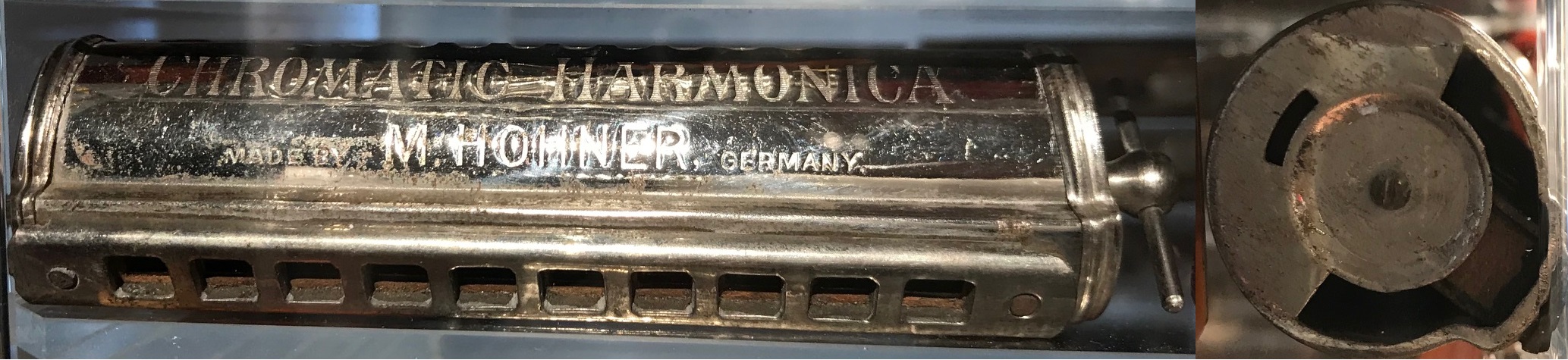
Bohm “Chromatic” harmonica from the music and winter sports museum, the manufacturing date must have been before 1920
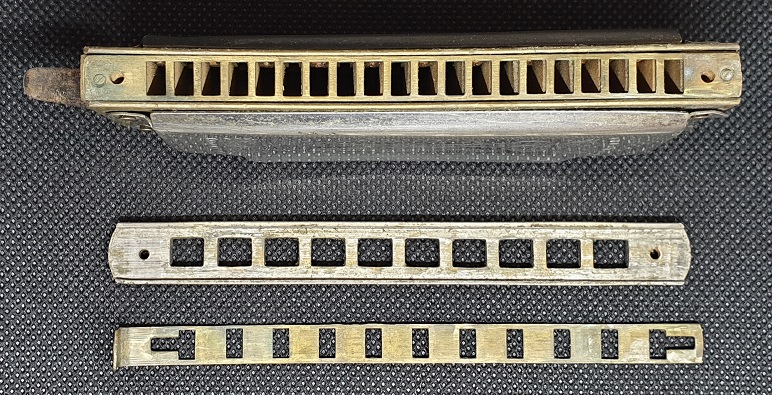
After some closer inspection, it was clear that some parts are missing. My assumption is that in order to play chromatically either the top or bottom channels must have been covered somehow. The principle could be similar to the Adolf Glass Junior harmonica from 1882, patent# DE19331A (see picture above).
Partially de-assembled Bohm chromatic. Some parts are missing
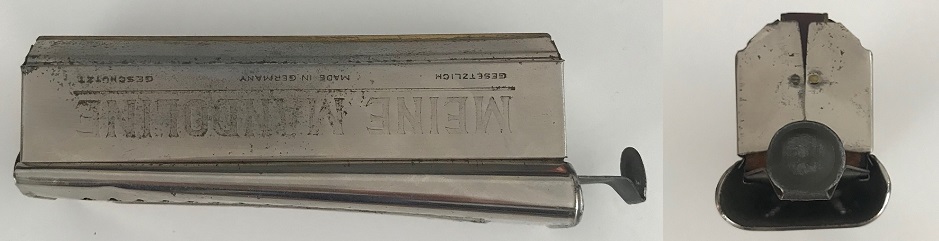
Another thought: the “Meine Mandoline” harmonica, manufactured by Bohm around the same time could have been used as a reference. Even though in that case the purpose of the slider was to create some sort of vibrato effect, a similar slider could have been used to cover some of the channels in order to play chromatic.
Bohm “Meine Mandoline” from around 1920, from my collection
Johan Richter double harmonica, from my collection
This Johan Richter harmonica is one of my oldest and most valuable harmonicas. It is not per se a chromatic harmonica as I will explain below.
I was very fortunate to acquire a double harmonica by Johan Richter from about 1875. The first time I saw a similar instrument was on a German television show where somebody presented a complete set of two single and a double harmonica:
A set of 3 Johan Richter harmonicas shown in a German TV show
I can narrow down the date of the harmonica to around 1875 based on the ribbon that is attached to the top of the accompanying quiver. It says Gebrüder Hug (Hug brothers). Hug was/is the biggest music store in Switzerland until today. The ribbon lists all store locations at that time. The latest store branch to open was in Lucerne (Luzern) in 1874-75.
Ribbon on the accompanying quiver
This double harmonica comes with a pair of top and bottom covers, which can either block the top or the button reeds, depending on pushing one of the lower covers towards the reed plate. This interaction automatically lifts the top cover up and blocks the lower one. By releasing the lower covers the opposite occurs.
Cover lifted up to show the reeds belowOpposite cover attached to a spring
Video demo of Johan Richter movable covers, courtesy Joel Andersson
In theory, it would have been possible to use that exact mechanism to play chromatically similar to today’s chromatic harmonicas. But instead of pushing a slide button, one could just push or release one of the lower covers. Besides, I was assuming that Johan Richter knew about the Joseph Richter Tuning. Based on his name it is likely that he is a relative or even Joseph Richter’s son. Unfortunately, I was not able to verify that assumption.
After some examination of all reeds and tuning, I got somehow confused. The tuning is definitely not even remotely chromatic and not very coherent. It is possible some of the reeds are out of tune, but I think I could in most cases detect that.
Below, you can find two tables. The first one lists all the notes of the left-sided harmonica; the second one of the right-sided harmonica. Maybe one of you has a theory why Johan Richter chose this tuning:
BN UR = blow notes upper reed plate BN LR = blow notes lower reed plate
DN UR = draw notes upper reed plate DN LR = draw notes lower reed plate
Left-sided harmonicaRight-sided harmonica
I took this description of a similar Johan Richter harmonica from the harmonica museum in Trossingen. It talks about the harmonica maker Johan Richter and his possible link to Johan Richter (inventor of the 10 hole Richter tuning), the functionality of the harmonica (see description above) and mentioned that the accompanying quiver has the names of the scales A flat, F, D flat and G flat written on it.
In the meanwhile I was in contact with some other collectors. Some of them sent additional pictures of similar harmonicas:
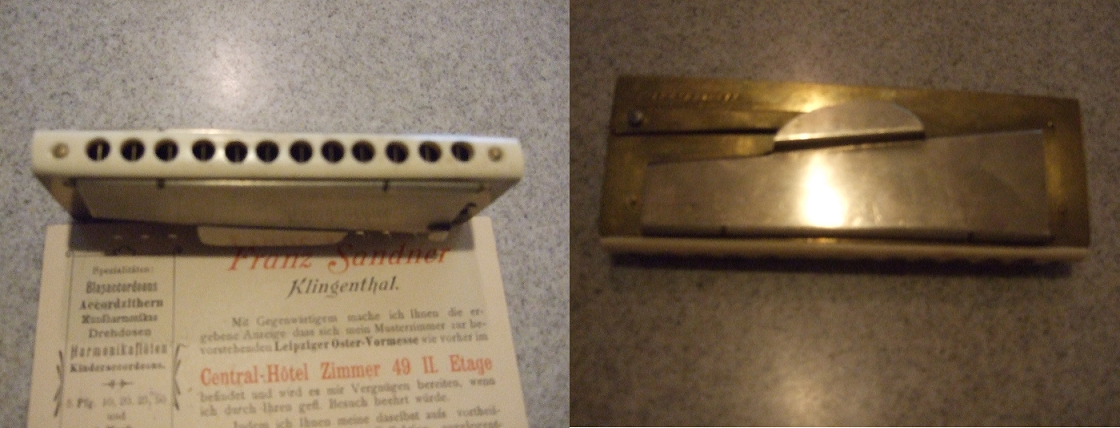
Franz Sandner harmonica (date unknown, courtesy of Rick Nielsen)The text on the photo states: approx. 1850 in Weiterglashütte (courtesy Isabella Krapf)
Weiterglashütte is in Eibenstock, Germany about 50 km distance to Klingenthal. Klingenthal is one of the major locations for harmonica manufacturing in Germany. What is interesting about this harmonica is the fact that the reeds were actually attached by rivets. Most harmonicas at that time had the reeds soldered to the reed plates
The harmonica in the photo below is based on a similar concept. It is a prototype from the old Hohner museum and shown in a video produced by the Norwegian television (starts at about 6:42). By pushing the left button down, the top cover gets pushed onto the top reed plate simultaneously lifting the bottom cover (same principle as described above).
Johan Richter Harmonica from the old Hohner museum in TrossingenJohan Richter Harmonica (same harmonica in color) form today’s harmonica museum in Trossingen
I am a collector of mainly historic chromatic harmonicas. Now, what does it even mean “chromatic” harmonica. There are several kinds of harmonicas. The main categories are diatonic, tremolo, and chromatic harmonicas. Besides, there are also additional types such as bass or chord harmonicas. I won’t go into any detail on those ones.
Diatonic, Tremolo and Chromatic Harmonica
One reason I got fascinated with chromatic harmonicas is that they allow you to play chromatically (like the white and black keys on a keyboard). That way you can play all sorts of music e.g. classical, jazz, blues, etc.. The chromatic harmonica distinguishes itself from other harmonicas because it uses a slider to switch notes (similar to the keyboard switching from white to black keys). Usually, the slider has a button attached to the right side of the harmonica.*
Slider Button
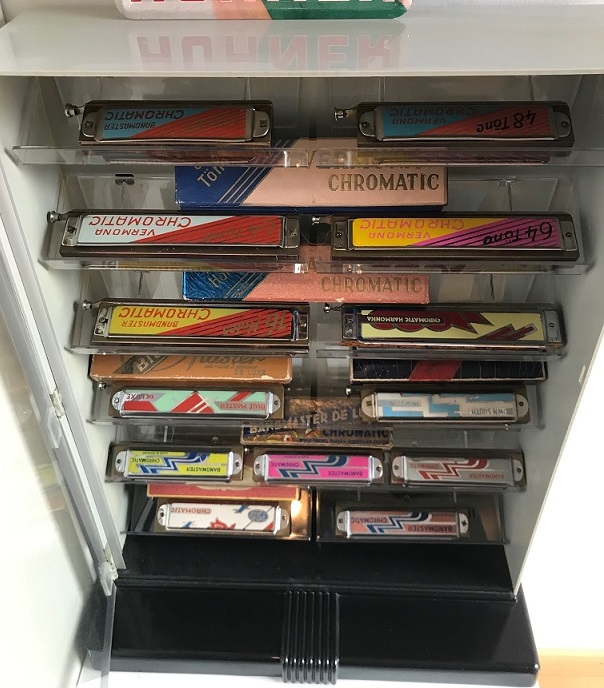
I have been collecting historic harmonicas for the last couple of years. During this time, I collected more than one hundred mostly chromatic harmonicas. Some of these harmonicas are very unique. They do have distinct shapes or colors. Some of them show special features or new inventions used for the chromatic slider or to improve the sound etc..
Below you can find a list of articles I wrote about the most impressive harmonicas in my collection as well as historical ones I don’t own (yet). These articles include pictures and as much information I was able to gather. The list is mostly chronological order, based on the release dates of the harmonicas. I would really appreciate your feedback and additional information. At the bottom of each page you have an option to submit comments.
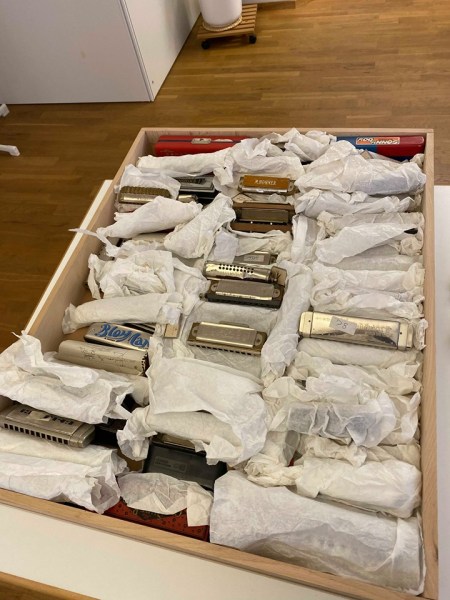
Update: by pure accident I got in contact with Joel Andersson, who actually very skillfully plays Irish music on a diatonic harmonica. Last year in November 2019, he went to the harmonica museum in Trossingen and was able to take a closer look at the harmonica treasures hidden away in a drawer. Those are mostly prototypes Hohner manufactured but never brought to market. He allowed me to use some of the vast amount of photos he was able to take during his visit. Some of those harmonicas will help me to add more info to some of the existing articles. I will also gradually add more articles about some of the “special” chromatic harmonicas Joel was able to photograph.
Hidden drawer with harmonica prototypes, courtesy Joel Andersson
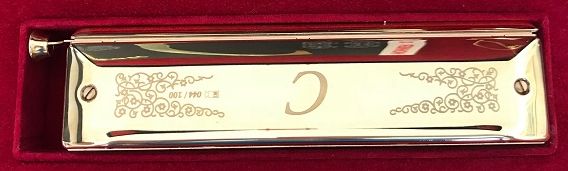
Info: the image at the top shows the Hohner “C” chromatic harmonica limited edition. It was issued in 2010 to commemorate the 100 year anniversary of the Hohner chromatic harmonica. Only 200 were produced. Mine is number 44.
*Note: there are many other kinds of “chromatic harmonicas” without a slider system as mentioned by John Broecker. Throughout this blog I will use the term “chromatic harmonica” exclusively to refer to chromatic harmonicas with a slider system.










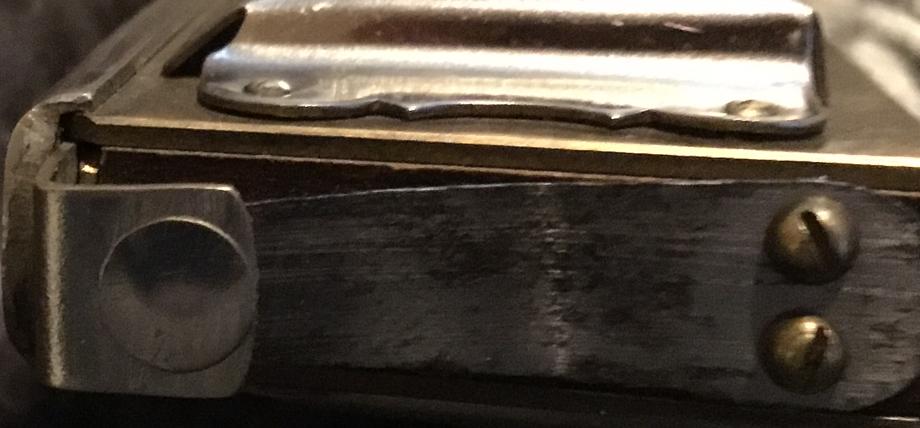
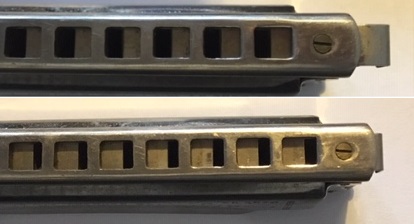


 Seydel chromatic from before 1920, courtesy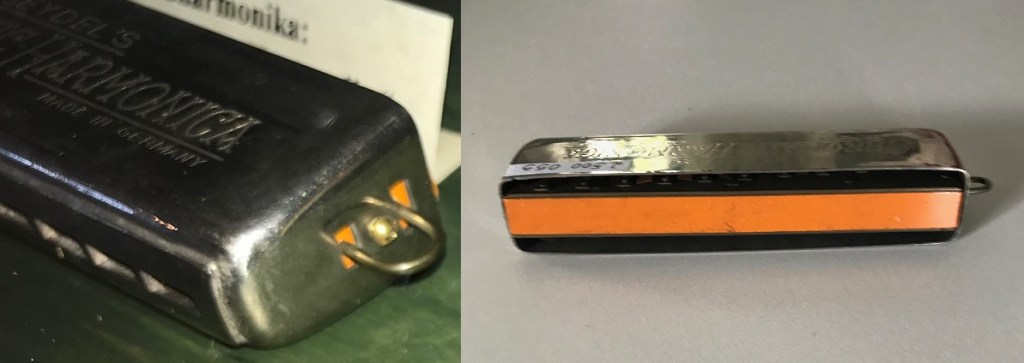










 Chromatic Harmonica History