The idea of an electric harmonica goes back to the 1920s. Pat Missin created a very informative page about this topic. He also shows a picture of the Hohner electronic harmonica prototype from the late 1970s. The prototype still exists. I had the fortune to take a picture of it at the harmonica museum in Trossingen, Germany. Unfortunately, nobody at Hohner can provide any information about its history. On top of that, the connector cable is nowhere to be found. Without that cable it is not possibility to get it to work. I would have loved to hear how it sounds. The first really useful electric/midi harmonica was the Millioniser 2000, invented by Walt Miller. You can find the full story story about it online. It was quite an advanced technology for its time.
Millioniser 2000, invented by Walt Miller
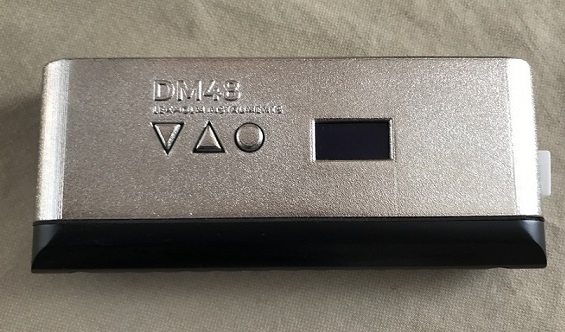
The DM48, developed by Erik Lekholm is the most recent addition to the world of electric harmonicas. The DM48 is a MIDI controller and needs to be connected to an external MIDI device.
DM48 Midi controller harmonicaDM48 with galvanized silver covers, from my collection
Update: Lekholm instruments just recently released an updated version of the DM48. The new model, DM48x has will add the following new features: -Wireless playing over Bluetooth Low Energy (BLE) MIDI -Ribbon controller: pitch bending or modulation via finger control -Built-in battery, for five hours of wireless playing -more onboard memory
New Lekholm DM48x, can also be played via Bluetooth
In April 2021 a new MIDI digital harmonica by the Chinese company Mozka Digital was released. Three models, HM12s, HM12 standard and HM12pro are available varying in features. All come with 78 onboard sounds. The instrument can also be used as MIDI controller for external synths. It features wireless playing via Bluetooth. Some more info (mostly in Chinese) can be found here. Brendan Power has a demo and review video about it on YouTube.
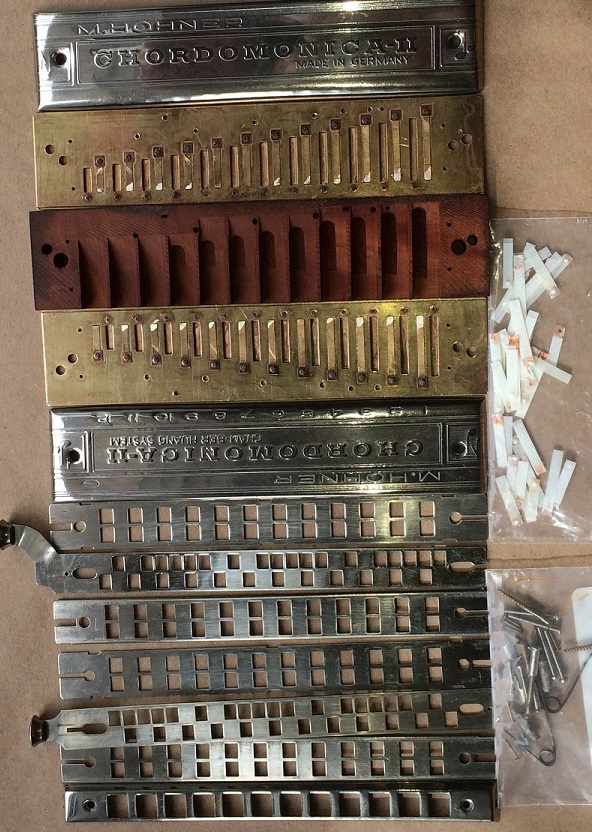
Chordomonica II from Hohner, invented by Cham Ber Huang around 1965Disassembled Chordomonica IIChordomonica I & II from my collection
Since 1981 Hohner discontinued the production of both models. The patent ran out in 1983. There are now some different custom version of the Chordomonica available.
4 and 3 Octave version using the standard Chromonica cover plates
There is also a Chordomonica project website with another custom version using a customized Hohner Discovery 48.
In 1967, the famous harmonica virtuoso Tommy Reilly went to a silver smith at Covent Garden, London to commission a new chromatic harmonica made out of silver. He talked about it in the following podcast dating back to 1973 (starting at 12:40):
At that time the Silver Concerto harmonica was one of a kind. It was essentially a Chromonica II (3 octave, 12 hole instrument) made out of solid silver.
In Uwe Warschkow’s book “Harmonica Lessons with Tommy Reilly”, Reilly remembers the following: “I always had the idea of a silver harmonica. Silver seemed to me the best material for it as it had proved its worth on the flutes. “ “The final impetus was that Robert Farnon composed for me ‘Prelude and Dance’. This work was both technically and musically so demanding, that I came to the conclusion that I can’t meet these demands with a standard ‘Hohner 270’.” “After getting the prototype from the silversmith, Douglas Tate, then a student of mine, helped me a lot with his technical skills to get it perfect. The result was an excellent instrument. From this time I only played on this instrument. It did not only sound better, it also gave the harmonica more prestige, as it became evident when I met and talked with conductors and orchestra members at rehearsals, recordings, and concerts. They all played expensive instruments. Beforehand, I often had the impression that for them the harmonica was considered more or less as a toy, and then they were surprised that I was able to make music with it. That had changed now.”
Tommy Reilly with the first Silver Concerto harmonica
Hohner Silver Concert Reilly continues, “… at one of my next visits to Trossingen I showed my new harmonica to the Hohner management and suggested to include it into their product range. They hesitated. I had the feeling that they did not want it, but would not like to say no. When I told them, which was a fact, that also Yamaha was interested in buying the product license, they changed their minds. Yamaha? Under no circumstances!” “Finally we made a contract and my development became a Hohner product and is known now as the ‘Hohner Silver Concerto’.”
Hohner Silver ConcertoHohner Silver Concerto, from my collection
Polle Concert Harmonica Georg Pollestad was never quite satisfied with the sound of a mass-produced harmonica. After a concert in 1980 Sigmund Groven let him have a closer look at his ‘Hohner Silver Concerto’. Then he told Sigmund that he is going to build such an instrument himself. As Sigmund told us later, he had thought, this man is crazy. However a year later, before a concert he presented his first self-made harmonica to Sigmund. Sigmund was surprised and so pleased with the quality of the instrument that he presented Georg Pollestad and his new harmonica to the audience, and played some pieces on the instrument. Since then, Georg Pollestad has continuously improved his first harmonica in close collaboration with Tommy Reilly and Sigmund Groven. Today, the ‘Polle Concert Harmonica’ is renowned throughout the world, and is played by famous soloists and harmonica enthusiasts. The instrument is made of pure silver and is absolutely airtight. Some of the major improvements include: • specially shaped air channels in the body, resulting in a warm and rounded sound, • a slide system that due to the minimal contact points is absolutely silent and does not stick, • a mouthpiece with specially shaped holes and small engraved lines on both sides. The lines, also on the front of the covers, support gliding the instrument along the lips. • LCD thermometer to determine correct play temperature • two-screw quick change reed plate removal system
Please check also the separate article about the Polle concert harmonica
The Vermonia was invented by Erwald Hochmuth, Klingenthal. I assume, he worked for the VEB Klingenthaler Harmonikawerke (previously VEB Vermona). The patent# DD27979A was granted in 1961. It is interesting that the slider can be moved to both directions in order to play different scales. Also, the harmonica body is adjustable to change the base key and chords.
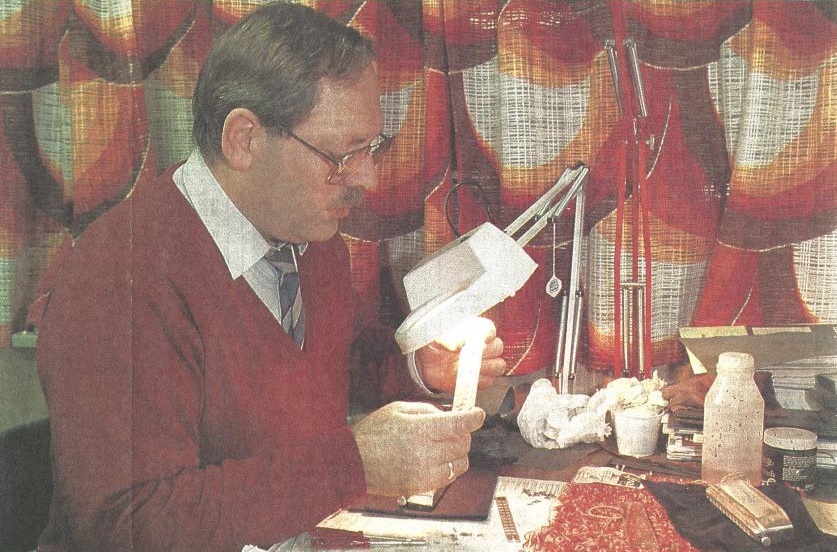
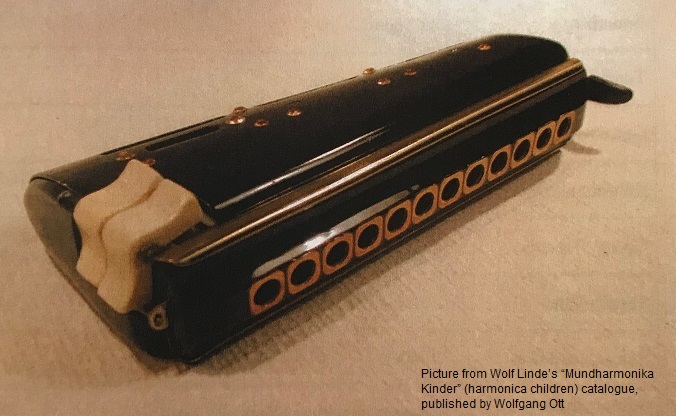
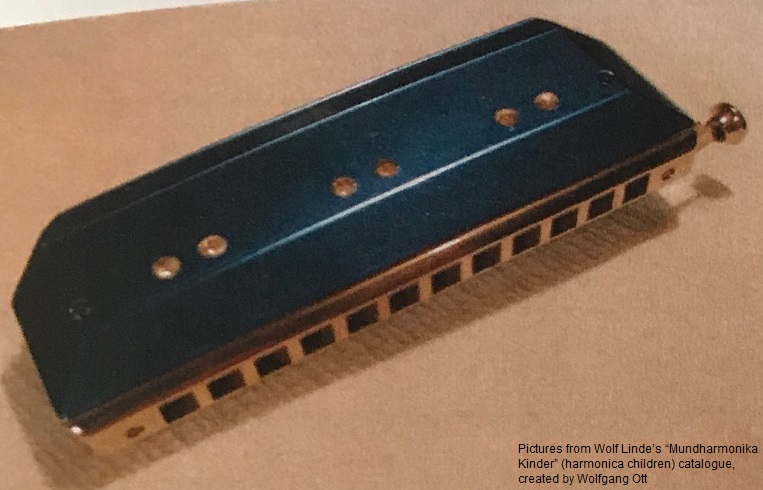
Wolf Linde is a former R&D engineer at Hohner. For more than 50 years he was contributing to many of the inventions coming out of the Hohner factory. He was also a member of the CX 12 development team. His name is included in the corresponding patent# DE 41 29 817 C1. The 65 pages catalogue “Mundharmonika Kinder” (all color prints) by Wolfgang Ott shows all the extraordinary harmonica prototypes Wolf Linde produced over five decades.
Wolf Linde’s “Mundharmonika Kinder” (harmonica children) catalogue, created by Wolfgang Ott
Linde Tremolo Chromatic from 1963
Linde Chromatic from 1974
The full catalogue can be ordered directly from Wolfgang Ott via e-mail.
Update:
Recently, I came across this Linde Prototype. It is not part of Wolfgang Ott’s catalogue. I assume Linde sold it of or gifted it to a catalogue or friend. This harmonica is really an interesting construction. The reeds are accordion rather than harmonica reeds. The slider rotates inside a tube. It has one design flaw though. There is no possibility to reach/repair an inner reed. A broken reed (or even a stuck valve) would render the instrument useless. Maybe that’s why it is only a prototype…
Wolf Linde chromatic harmonica prototype, from my collection Wolf Linde prototype disassembled, from my collection
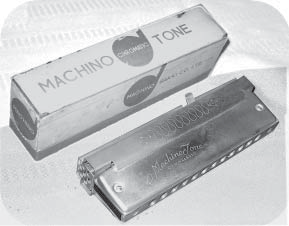
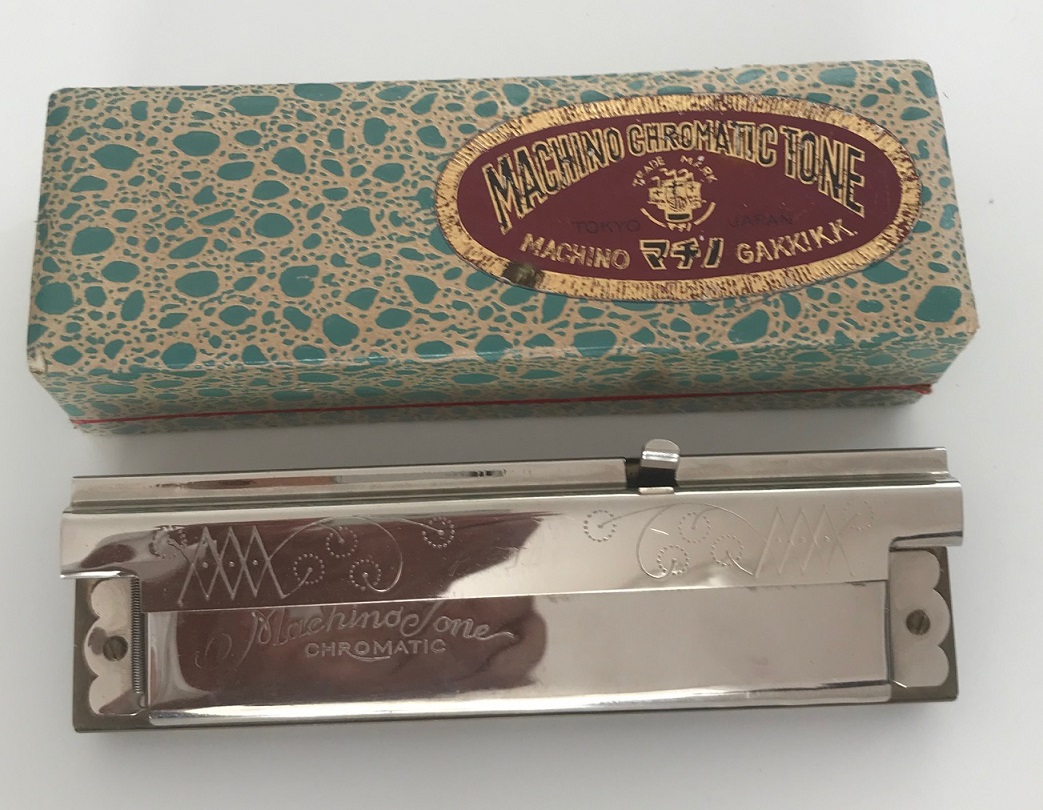
The Machino Tone chromatic was invented by the Torahachi Machino company of Tokyo in the 1950’s. According to several patents given in different countries, the earliest being from Britain (Patent 819441) and Switzerland (Patent 352220), the Machino Tone might have been available around 1957. The U.S. patent# 2,877,679 was granted in 1959. As Pat Missin mentions on his website, a similar invention was already mentioned in patent# DE19221 by Adolf Glass Junior from 1882 (see also my previous post on the Glass Junior harmonica) .
Our reliable expert, Stan Harper, recently wrote of an intriguing Japanese harmonica… Stan writes: In the 1950’s, a German, whose name I forget, came to me with a Japanese harmonica he was importing. He wanted me to play and promote it. I had two or three which I eventually gave to Andy Paskas [a passionate and eccentric harmonica collector of Canadian background, well known to many of us, including your editor]. It was the most powerful 12-holer I’d ever played. It had no conventional mouthpiece and slide. Instead, the airflow was directed by a [rocking] damper, controlled by a pair of springs, which normally prevented air from flowing through the Db reeds, thus allowing only the C reeds to sound. When the damper was rocked, by a tab [on the back of the harmonica] it covered the C openings and allowed the Db reeds to sound. It was the best harmonica I’ve played to this day. It had one major drawback: the damper had to be worked up and down with the index finger. This motion is contrary to how the hand works. I could never play accurate rapid technique or cup it properly. Here we have to disagree with Stan. We heard him play this harmonica, and his technique was quite rapid enough to suit most of us!] The system is 100% superior to the mouthpiece and slide setup. It never gummed up or needed any care. I told the importer that if they could make some sort of arrangement whereby an operating lever could be placed on the right side like the slide button, it would be the best harmonica in the world. As it was, however, it was a loser. (There were many wonderful harmonicas, but bigger companies either bought them out or put them out of business by preventing stores from handling them.) Well, Stan, we don’t remember the German importer’s name either, but his company was “Worldwide Musical Instrument Co.” He had been seeking someone to write and design a small sales brochure for him. This was not long after we had written an instruction book for Hohner and someone at Hohner recommended us. We got the assignment, but probably forgot him deliberately, because he stiffed us on some of the money he owed…quite different from Hohner, who always treated us right; we still have some spare reeds and springs and other odds and ends they gave us years ago. The name of the harmonica was “Machino Tone”. This had nothing to do with machinery; the inventor’s name was T. Machino. Here are pictures of both the “Machino Tone” and the brochure we created for it. As Stan says, it was a terrific concept…easy to blow, and quite loud. Also, as he says, there was
no slide to stick, or get “gummed up”. Despite a preference for a 16-holer, your editor played the Machino for quite a while (using his middle finger on the lever), but it eventually sort of fell apart (the Machino, not the finger). It needed three combs…one between the reed plates, one above, and another below. The above and below combs were not made well, in our opinion, and they were very hard to repair–to make airtight—once they
Two sides of the brochure
disintegrated. Of course, Stan’s point about the somewhat awkward button or lever is well taken, too. It was a whole new learning experience. But, as we stated above, Stan flew over it pretty darn well, no matter what he says now. Today, with molded plastic combs and such, it might be possible to make such an instrument that would be really durable. With a button in the right place, it would be fantastic! Incidentally, the Worldwide Musical Instrument Co. was located at 404 4th Ave., New York 16, New York, across the street from Hohner’s old location at 351 4th Ave. (Note the nostalgic two-digit postal zone, dear REEDers. Today it’s zip 10016, and real estate values on 4th Ave. have been boosted by simply renaming it Park Ave. South.)
The “Machino-Tone” with back housing removed, to show the “damper” and finger lever. Two springs (one is visible) hold the damper against the upper air outlets, thus letting the lower (C) row of reeds sound. Pressing the lever closes the lower outlets and opens the upper (Db) outlets.
Torahachi Machino also invented two tremolo chromatics with a similar mechanism.
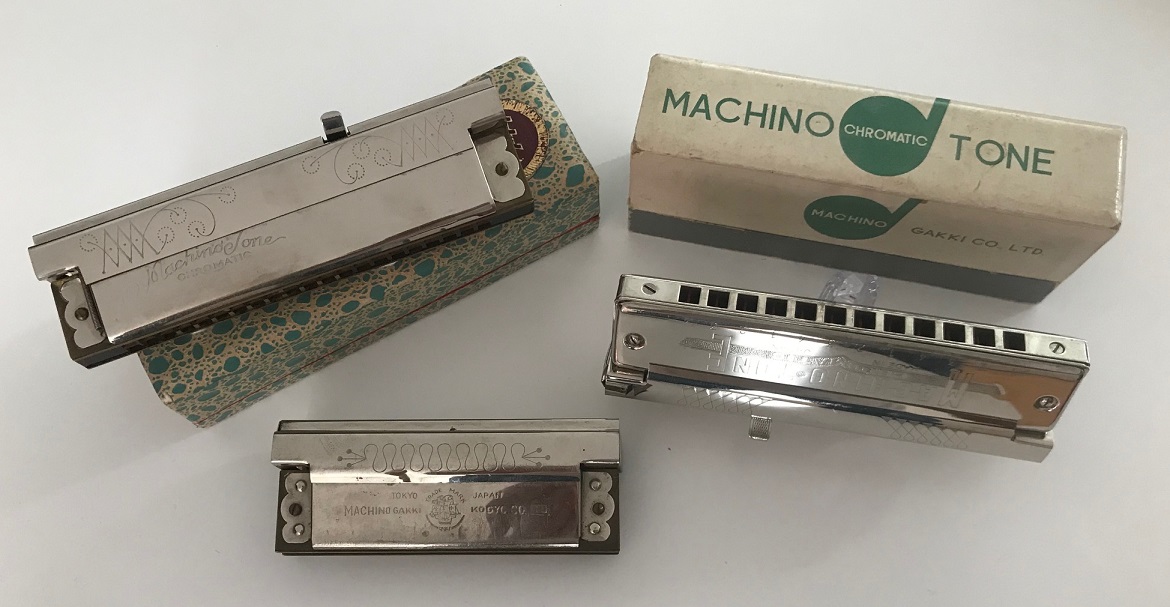
Machino Tone tremolo chromatic grand (left), tremolo chromatic (middle) and chromatic (right), from my collectionRare 21 hole Machino Tone Tremolo chromatic, from my collectionInstructions for the Machino Tone chromatic
The Meteor chromatic must have come out around 1954, at least that is the time when the patent# 8724 was granted to Helmut Hoyer, Klingenthal. Helmut Hoyer worked for the VEB Klingenthaler Harmonikawerke. The interesting thing about the Meteor chromatic is its curved mouthpiece as well as the assembly of the push button. The button is attached to a lever. The lever pushes against a spring to change the position of the slider and therefore to change keys. VEB came out with two models. One with a gold the other with red labeling.
In 1937, Archimede Mancini founded his first factory, “La Fisarmonica” together with Egisto Bontempi in Potenza Picena, Castelfidardo, Italy. After the war in 1950, Mancini relocated his company to the city of Pesaro, Italy. He passed away in 1976.
The design of his first chromatic harmonicas pretty much resembled the Hohner Chromonica.
Mancini 3 and 4 octave harmonicas, from my collection.
The 10 and 12 hole chromatics that followed were very unique, stylish, and had very particular shapes. They were branded “London Pride” and “Mondial”.
10 hole Mancini chromatics, from my collectionLondon Pride 12 hole chromatic from my collection
So far I have seen the Mancini chromatics in silver, black and red.
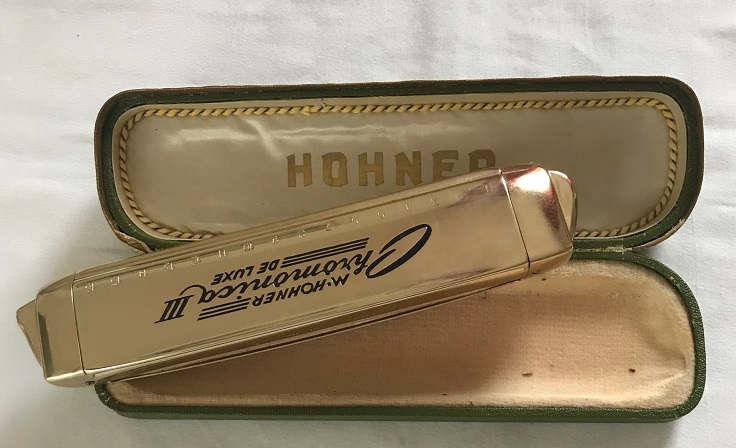
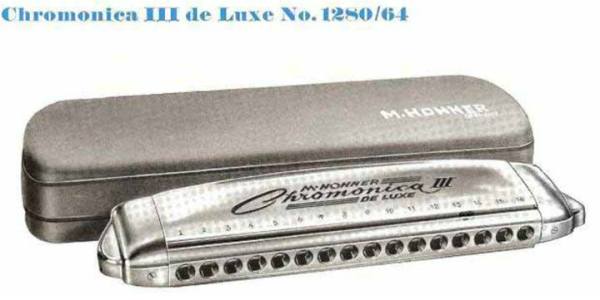
At the beginning of the 1950s Hohner came out with two new models, a 10-hole Chromonica I De Luxe and a 12-hole Chromonica II De Luxe. The patent# 853853 was issued to Walter Hohner in 1952. More info can be found on Pat Missin’s website. As Pat mentions, the US Design Patent# 166750 was also issued to Walter Hohner the same year. I’ve recently read an interesting article about John Vassos. Especially this part got my attention: In the late 1940s, John Vassos was hired by Hohner to design harmonicas and accordions with his signature modernist and streamlined aesthetic, primarily aimed toward the American market. Vassos’ design drawings feature marks resembling air whooshing past his harmonicas—musical spacecraft traveling through the galaxy of his imagination. I could actually imagine that John Vassos is the father of the Chromonica Deluxe design.
Chromonica I and II De Luxe from my collection
1953 Chromonica III De Luxe special edition from the harmonica museum in TrossingenAnniversary Chromonica II De Luxe: “Ernst Hohner, der Förderer der Chromonica zu seinem 60. Geburstag” (Ernst Hohner, patron of the Chromonica to his 60th birthday), special edition from the harmonica museum In addition, Chromonica III De Luxe prototypes were produced later.Chromonica III De Luxe, from my collection
Chromonica De Luxe illustration from the 1950 Hohner catalogue
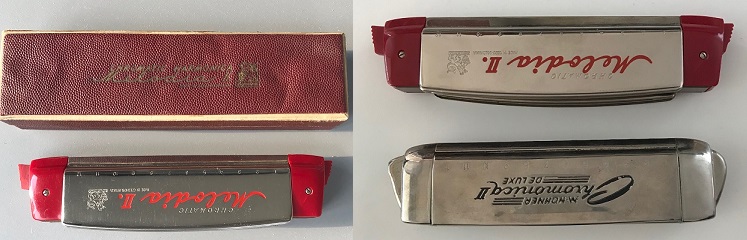
The Melodia II manufactured by the Czech company Lignatone might have taken some cues from the De Luxe chromatic.
Melodia II from Lignatone (left), there are some similarities between the Melodia II and De Lux.
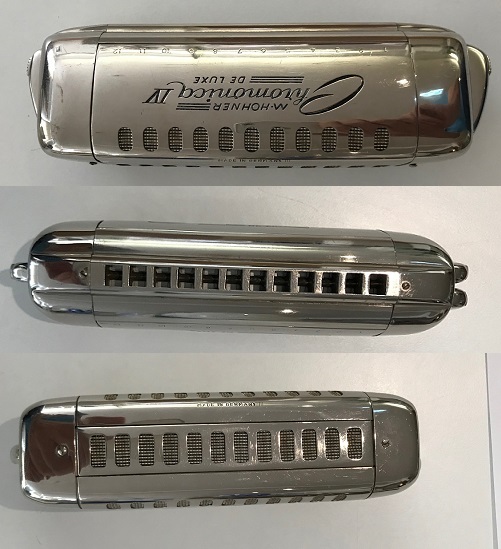
Update: I finally had the chance to go back to the harmonica museum in Trossingen to take a closer look at one of the most unique and stunning chromatic harmonicas out there, the Chromonica IV De Luxe. Martin Haeffner from the museum and Gerhard Mueller from Hohner were kind enough to allow me to spend some time analyzing and taking pictures of the instrument.
Hohner Chromonica IV De Luxe side, top and bottom view, from the harmonica museum Trossingen
I’ve always wanted to get a deeper knowledge of that instrument. Maybe one day I will even be able to re-manufacture one. According to its patent, it consists of two combs with two pairs of reed plates. I was curious to find out how those different reed plates were tuned and how they interact with one another. I made a short recording carefully blowing into the instrument and utilizing all three buttons:
First chord w/o any button pushed blowing a chord, second blow chord with right button pushedLeft buttons pushed (first top then button) while playing blow chord
I quickly realized what was going on: when blowing into one hole without using any buttons, one can hear two notes an octave apart. E.g. when blowing into the first hole one will hear the middle C# and the C# one octave below. Contrary to a regular C tuned chromatic, one needs to press the right button in order to hear the middle C. Otherwise, the order of the notes is identical to a standard 3 octave C tuned chromatic.
The purpose of the two buttons on the left side is to allow for single note playing. E.g. when only pushing the top left button and blowing into the first hole, the middle C# will play. When only pushing in the bottom left button the C# below middle C will play. This gives the De Luxe IV a range of 4 full octaves.
The two left buttons can be locked into position (one at the time)
I was able to take off some of the outer covers to see more of the internal mechanism of the instrument. Based on the fact that the reed plates are custom made and some scribbled notes on the reed plates, it was clear that this was the only prototype. Unfortunately, this instrument never went into mass production. The De Luxe IV consists of many small parts interacting with each other, i.e. the locking mechanism of the left buttons. It was probably just too difficult to mass produce this instrument.
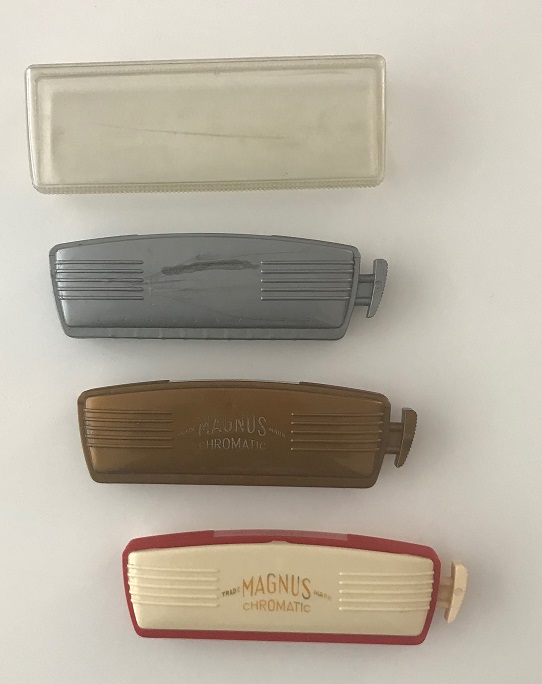
Magnus plastic chromatic harmonicas, from my collection
The Magnus Harmonica Corporation (founded in 1944 ) started producing plastic harmonicas (US patent US2407312A) at the beginning of 1948. Besides chromatic harmonicas, the Magnus corporation also produced 10-hole diatonic and tremolo harmonicas. More information on the different harmonicas as well as a short and a more extensive description of the Magnus corporation history can be found on Pat Missins’s website.
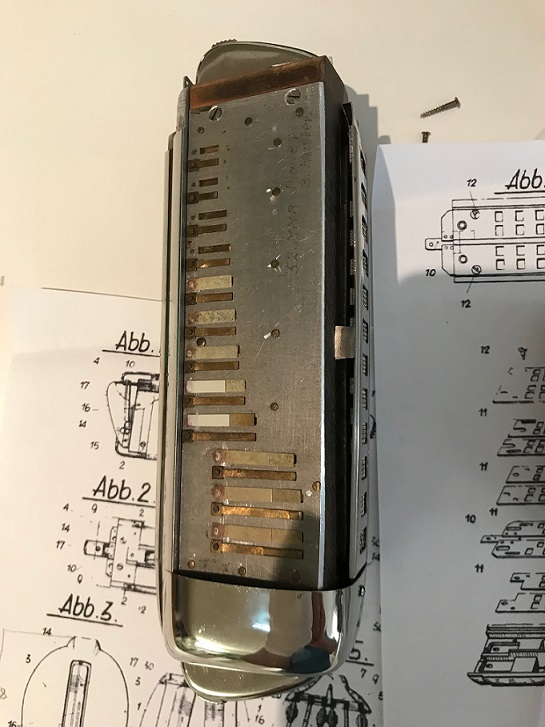
The interesting invention is that the whole harmonica was made out of plastic, including the reeds. Furthermore, the slider mechanism works similar to the one used for the Böhm Chromatic with movable reed plate: in this case, the reed plates and the comb are moved to the left when the button is pushed.
Magnus chromatic showing the plastic reed plate and reeds as well as how the slider mechanism works
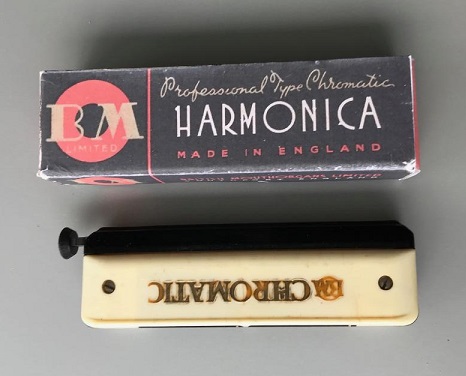
Other harmonica manufacturers like the British Mouthorgan Company (BMO) were striving for some of the Magnus success:
Excerpt of an article written by John Cook for the December edition of Harmonica World about the British Mouthorgan Company10-hole BMO chromatic harmonica entirely made out of plastic, from my collection


















 Chromatic Harmonica History